Showing posts with label end of the year. Show all posts

Rockets Project a Success! Fun day launching today


I love rockets. My Bachelor's degree is in Aerospace Engineering and I've been interested in rockets since I was a kid. My dad worked on the main engines for the Saturn V rocket when he worked at Pratt & Whitney as a chemist, I've designed and manufactured parts for the space program as an engineer, and my senior project in college was designing a two-state-to-orbit space vehicle (and we got to work with NASA engineers on the project - very cool!). I've found that all kids seem to have some interest in rockets and I use that as a great end-of-the-year project in my physics class.

Today was Rocket Launch Day for my Physics classes. It's the finale to their last project of the year. We launch their rockets multiple times, even having a little fun and doing modifications to the fins and rocket to see what happens. It was slightly overcast with 5-10 mph wind out of the SouthEast, but we only lost two rockets into the trees near the field. We use A8-3 and B6-4 engines, with average impulses of 2.5 N-s and 5 N-s and maximum thrust of 10 N and 12 N, respectively. Average altitudes for these rockets are between 150 and 300 feet.

Here are some pictures some students took from today's launches.

A couple of the students jump when the 1st rocket launches


That's me at the launch controls. 


Their end of the year project is to research, design, build, analyze, and launch model rockets. The project combines physics concepts from throughout the year (stress, stability, aerodynamics, Newton's Laws and Forces, energy, impulse, matter and chemical energy, fluids and more) as well as helping students to continue to build their teamwork, communications, and problem solving skills. They have to use physics concepts to predict the altitude the rocket will go (based on mass, aerodynamics, forces and impulse). We then use trackers to measure the angle for the rockets, and knowing the distance the trackers are from the launch pad they can use trigonometry to find the actual altitude. They then have to complete a project report with all of their design information, calculations, analysis, and why their predicted and actual altitudes were different (usually are) along with any issues they had.

It's a great project to end the year. They learn and have fun all at the same time.

Cover of the Rockets Educator Guide+

I found a great resource from NASA - The Rockets Educator Guide - that includes lesson plans and activity ideas. NASA's site is a great resource for this type of project. This guide has some great activities like rockets using film canisters, baking soda, and vinegar, paper rockets, altitude trackers and more. There is even a part on the history of rockets.

The students start the whole unit with a WebQuest on NASA's site about rockets - NASA's Beginners Guide to Rockets: http://www.grc.nasa.gov/WWW/K-12/rocket/index.html This site helps them tie all the physics concepts together and apply them to rockets. It also explains how model rockets work, from the engine propellant and nozzle, to the recovery system and ignition system.
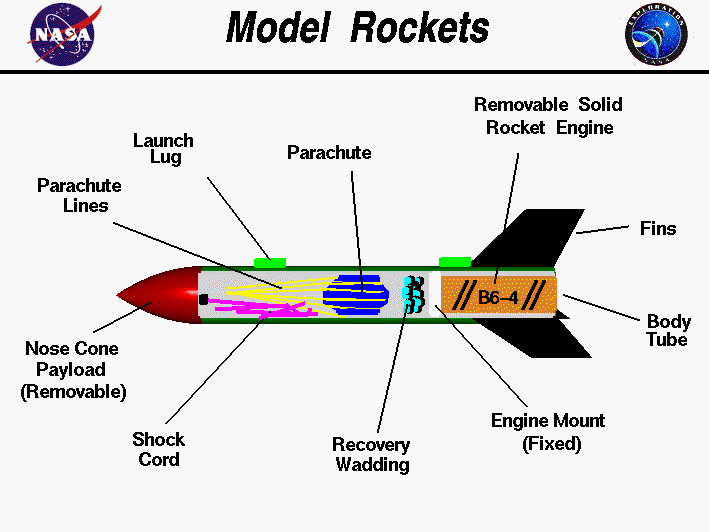

Computer drawing of a model rocket with the parts tagged.

You can extend the unit and do more activities from the educators guide. You can also have students research space missions, current spacecraft, and the future of space travel.

Discovery Education Streaming has some great videos and resources, including the "NASA at 50", "Bill Nye Great Inventions" and "When We Left The Earth: The NASA Mission" series.

The students learn a lot, see an application of what they have learned, work as a team, and have some fun. It's a great way to end the year.

Topics in this unit:
history of rockets
transportation
energy transformations
fluid dynamics
thermodynamics
aerodynamics
chemistry of solid fuel engines
stability
Newton's Laws
Gravity
air resistance

Skills:
Teamwork
communication
reading comprehension
manual dexterity
application of knowledge
problem solving
math

Resources needed:
computer with internet to connect to NASA website
NASA Rockets Educator Guide - free
Model rocket kits, engines, and launcher (available from a variety of companies and suppliers. I use Estes).
(funding for these supplies have been through Donor's Choose and an Air Force Association classroom grant).

Rockets resources:
NASA's Beginners Guide to Rockets: http://www.grc.nasa.gov/WWW/K-12/rocket/index.html
Estes Model Rockets - Educator Page: http://www.esteseducator.com/
Apogee Rockets - http://www.apogeerockets.com/ (click on "Educational")
National Association of Rocketry: http://www.nar.org/teacher.html

  • Digg
  • Del.icio.us
  • StumbleUpon
  • Reddit
  • RSS

End of the School Year Approaches - lesson ideas and reflections


We are quickly approaching the end of the school year. Advanced Placement Exams start in two weeks, effectively the end of AP classes (although I do a lot of projects with my AP students after their exam) and senior finals start the end of May. The student's last day of school is June 19th, but exams are finished on the 15th. Teachers finish on June 19th. I teach 95% seniors, so I have to finish up everything by May 29th when Senior finals begin. 

As I was looking over the schedule and working on my lesson plans for next month, I was trying to decide what I would do with my students. I use web quests, videos and activities from Discovery Education, and projects to keep my students learning during a time of distraction. I also use the videos from Discovery Education to share topics that we normally don't cover or don't have time to go over as a full unit. The videos are great for that, explaining topics with demonstrations and examples in 40 minutes or less. 

Senior Prom, Junior Ring Dance, end of the year, Spring Fever, Senioritis. They all affect schools around this time. So, I use the projects. Think of projects related to your curriculum that would be great to do at the end of the year and use that instead of lectures, problem sets, or standard labs.

The rockets project is my favorite and my students favorite. They look foward to it all year. The web quest incorporates elements from NASA's web site. The students are applying multiple areas of physics during this project: energy, chemical reactions, fluid dynamics, forces, Newton's Laws, and more. They get to work in a group and do something hands-on and creative (they get to decorate the rockets any way they want and they are also able to do different fin designs). The best part is launch day. The students get to go outside and launch rockets. I handle the actual launching so that I can ensure safety, but the students love the countdown and watching the launch. They also have to chase down rockets that drift in the wind. Who wouldn't want to be outside launching rockets on a beautiful Spring day?. The students do calculations ahead of time to predict the altitude their rocket will go, and then we measure the actual altitude with trackers and trigonometry.  They learn some great physics topics while having a lot of fun.


Computer drawing of a model rocket with the parts tagged. 

Another thing I start doing around this time is to reflect on the past year. What worked? What went right? What went wrong? How did I handle classroom management issues? How well did my students learn? Lots of questions to answer and get ready for next year. I do this throughout the year too, but this is the point where I can really plan and make changes for the following year.
One thing I do to as an evaluation of the year is to have my students fill out a survey about the class and their experience. It asks them to rate things such as was the classroom and equipment (labs and projects) adequate, was enough time given for demonstrations and review, how well did the teacher answer student questions, and their thoughts on assignments and work given. It also asks about me: did I set a climate that was conducive to learning, did I effectively communicate with students, did I address their needs and issues, and were the teaching methods effective. I also have space for them to write comments about what they liked about the class and what they think should be improved. They can put their name on it or it can be anonymous.


I do take the surveys with a grain of salt. Some students write all "4" (highest score) and some complain that everything was too hard. But I do get a lot of great feedback and ideas. Some times I am surprised by the level of sophistication that I my students have and how insightful they are about their classes. (I've also used this model with pre-service teachers).


After I've read through all of the surveys and taken notes, I sit and think about the whole year. I try to be critical of things so that I can really evaluate how things went. I am going to implement some of the things I've come up with and some of the things my students noted, but I am also going to keep my lessons flexible so that I can modify them once I've met my students next year and see what they are like and what they need. I believe in constantly assessing how I am doing as an educator and how well my students are learning and changing and modifying things as needed throughout the year. The end of the year and summer are great times to come up with lots of different ideas so that I have a collection of ideas to use next year.


This year I've been using the classroom blogs and Google Forms to get more feedback from the students throughout the year. I also use a Google Form instead of paper for the final class evaluation, and student information forms. 


As I write this, I keep having thoughts about issues I've had and how to change them next year. I'm also thinking about the type of teacher I am and what I can do to improve my attitude and persona to make me better. I think one of the things I'm going to do this summer is to actually relax a bit instead of working to much to recharge myself. I will be attending a few conferences and will keep active with my PLN (Personal Learning Network) to share ideas, thoughts, and resources. I want to come back to school next year enthusiastic, motivated, and ready to have some fun while educating. 


So, let's hear from you:

What do you do in your classroom at the end of the year to keep students focused and engaged?


How do you evaluate teaching and learning in your classroom? 


What do you do at the end of the year and summer to prep for the next year?


Related:

Rockets - a great project for the end of the year for any class


  • Digg
  • Del.icio.us
  • StumbleUpon
  • Reddit
  • RSS