Showing posts with label biology. Show all posts

CellCraft - learn about cells through interactive game


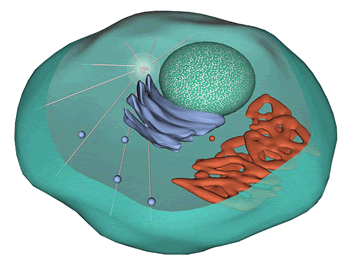
CellCraft is a free interactive game were students learn about the cell as they play the game. It is free to download (as long as you give credit) in three different formats: SWF for embedding on webpages, EXE to play on a Windows computer, and APP to play on a MAC.

The creators are also developing a downloadable teacher's packet with more information about the game and lab for students to use as they play the game.


They also have a blog and forum on the site for users to share and get information and tips. There is a separate category in the forum for teachers too. http://cellcraftgame.com/forums/index.php?board=9.0

This is a fun way for students to learn about the cell.


  • Digg
  • Del.icio.us
  • StumbleUpon
  • Reddit
  • RSS

BioLogica - interactive Biology lessons and learning resources


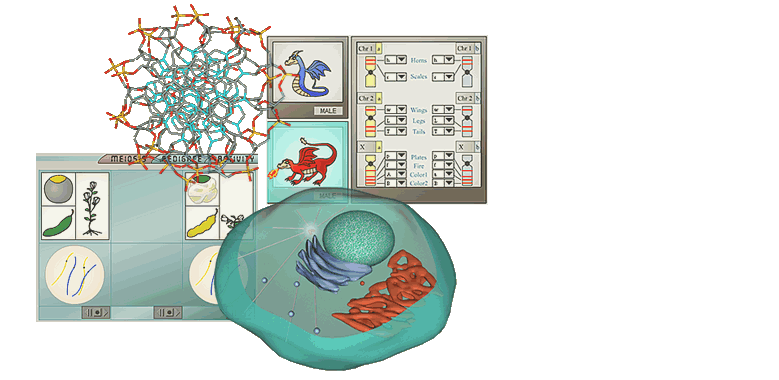
BioLogica is a site that has interactive labs and learning activities on biology that help students learn concepts. Students work through the activities, get feedback and hints and create a portfolio of their work.


BioLogica runs on Windows and Mac's. It doesn't just help students learn concepts in Biology, it also helps them make connections between different concepts and ideas. It focuses on genetics, including helping students to learn the parts, processes, and mechanisms of genetics.

The activities pose a problem for the students and then lets them solve it. The software will have the students explain their reasoning, help them with hints and eve suggest additional resources and material to help them. Teachers can monitor student performance and collect the student work into electronic portfolios.

There are also 3D interactive models of the cell on the site. These are great for helping students learn about the cell.


There are demos of the activities on the site and you can download a free copy of the prototype version of the software.  http://biologica.concord.org/index.html


  • Digg
  • Del.icio.us
  • StumbleUpon
  • Reddit
  • RSS

Nature Works Everywhere - free resources for learning about nature's factory


Nature Works Everywhere is a great, free site from The Nature Conservancy and Discovery Education. The site has resources to help learn about how nature works and the fact that nature is a factory, making many of the things we need.


There is an interactive online game that helps students discover the connections between everyday items and nature's resources, interactive lesson plans about topics like pollinators, forestry, coastal erosion and more, videos about how nature works to benefit us and how we can preserve nature, and a section about scientists working to preserve nature and keep it productive. There are even some virtual field trips.

Check it out and share it with your colleagues: http://www.natureworkseverywhere.org/


NWE email footer


Related:

Tons of Great Resources from Discovery Education

Great Resources from Discovery Education 

Turfmutt - environmental lessons and resources

  • Digg
  • Del.icio.us
  • StumbleUpon
  • Reddit
  • RSS

Understanding Genetics-Human Health and the Genome - free resource from Stanford U


Understanding Genetics: Human Health and the Genome is a free resource from Stanford University School of Medicine and The Tech Museum.

There are online exhibits, news, activities, resources, articles, videos and much more about Genetics. There is even an "Ask the Geneticist" page with questions and answers. The topics include what are genes, diseases, mutations, medicines, news, and more.

The activities and resources are very well designed, engaging, and educational. It is an excellent resource for teaching genetics and can be scaled for multiple grade levels.


DNA   


Related:

Scitable - biology and life science resources for educators
Learn Genetics - great resource with virtual labs
Genome - resources about the National Genome project


  • Digg
  • Del.icio.us
  • StumbleUpon
  • Reddit
  • RSS

Excite - epidemiology resources & activities from the CDC


EXCITE! is a program developed by the CDC to teach students about the causes and prevention of disease and injury while improving their research and analytic skills. Students learn the scientific method employed by epidemiologists—or disease detectives—and use what they have learned to solve real disease outbreaks on their own. The materials are geared towards grades 7-12 but can be adapted for the lower grades. 


EXCITE

There is a page on epidemiology in the classroom that explains epidemiology and how to track and investigate and outbreak. There are lesson plans and activities included. There is a resource library available with links to more information and resources. 

The outbreak investigation is a great activity that combines content knowledge and skills. 

This is a great resource for biology and health classes to use (as well as other classes in science, math, and other areas) that teaches content, scientific method, problem solving, critical thinking, and more. 


Related:

BAM - Great Education resources from the CDC

  • Digg
  • Del.icio.us
  • StumbleUpon
  • Reddit
  • RSS

BAM - Great Education resources from the CDC


The CDC has some great resources for educators, including one on Concussions in children and sports. I just found another part of their site that has more educational resources.

BAM - Body and Mind - is a collection of resources for educators and students aged 9-13 (although you can scale the materials upward). The site has information about healthy lifestyles, diseases, stress, food and nutrition, physical fitness, safety and the human body.


The educator resources include interactive activities and lesson resources that are linked to the national education standards for science and health. There are handouts, lesson plans, and links to other resources.

The activities are fun, well-designed, and educational and can be used in a health or life science / biology course.


  • Digg
  • Del.icio.us
  • StumbleUpon
  • Reddit
  • RSS

Be The Beat - learn CPR in a fun way - from the American Heart Assoc.


Be The Beat is a great resource from the American Heart Association. The site has educational games and resources to learn CPR. It's a great resource to use with your students to teach them CPR and there are specific resources for educators on the site with lesson plans, posters, training resources, emergency planning resources, information about the challenge competition, and more. HeartTrek is a very cool, 3D exploration game on the site that allows students to learn about heart health, explore a 3D model of the heart, and a virtual cardiac arrest that they can play to try to save a life.

As a paramedic with over 23 years experience, I can tell you that bystander CPR is one of the most critical factors in helping a cardiac arrest victim to survive. Use this site to teach your students how to save a life!
Sudden Cardiac Arrest can strike anyone, anywhere—and when it does, a victim’s chance of survival depends on the people around them. That could mean you! Fast recognition, calling 911, immediate CPR and use of an AED (Automated External Defibrillator) can double—or even triple—a victim’s chance of survival. So how do we improve the odds?* 
We're Training a Team of Heart Heroes
Be the Beat is an online Sudden Cardiac Arrest awareness initiative to teach teens all across the country the simple steps that can save a life—and create the next generation of lifesavers. 
Don’t Just Stand There!
It only takes a few minutes to learn about a critical skill that could save a life. You can make a difference! Check out the games, music, videos and giveaways here and join the movement of teen lifesavers—just like you—who are ready to step in and Be the Beat if they ever need to.
Teachers and administrators can visit bethebeat.heart.org/schools to find free tools that can help start and sustain CPR and AED programs. 


About the American Heart Association
For more than 40 years, tens of millions of people—from new parents to advanced medical professionals— have trusted the American Heart Association to deliver their lifesaving CPR training programs and materials. We sponsor the international evaluation of current resuscitation science that leads to the American Heart Association Guidelines on Cardiopulmonary Resuscitation and Emergency Cardiovascular Care, for CPR training guidelines used by hospitals, schools and EMS systems in the U.S. and around the world.
* Statistics: Almost 80% of sudden cardiac arrests happen outside the hospital, less than 30% of victims receive bystander CPR and only 8% survive to hospital discharge.

  • Digg
  • Del.icio.us
  • StumbleUpon
  • Reddit
  • RSS

Bones, Stones, and Genes - the Origins of Modern Humans, - free education resource


The 2011 Holiday Lectures on Science

Bones, Stones, and Genes - the Origins of Modern Humans, is a new free resource from Biointeractive, a great site from the Howard Hughes Medical Institute. It was one of the lectures from last year, but the DVD (free) is now available.

In Bones, Stones, and Genes, three leading researchers of human evolution reveal the fossil and genetic evidence chronicling the origin of humans. It is available as streaming videos (or downloads) and as a free DVD. It is divided into parts:

Lecture 1: Human Evolution and the Nature of Science by Tim D. White, Ph.D.
Lecture 2: Genetics of Human Origins and Adaptation by Sarah A. Tishkoff, Ph.D.
Lecture 3: Stone Tools and the Evolution of Human Behavior by John J. Shea, Ph.D.
Lecture 4: Hominid Paleobiology by Tim D. White, Ph.D.
Discussion: Genetics of Bitter Taste Perception
Discussion: Reporting Scientific Results to the Public

There are lectures, interactive features, videos, animations, student discussions, interviews and even Spanish subtitles for ELL.

The lectures and materials on Biointeractive are excellent and a great addition to any teacher's resources. 


  • Digg
  • Del.icio.us
  • StumbleUpon
  • Reddit
  • RSS

How Vaccines are Made - very cool and informative site


Vaccines are pretty amazing when you think about it. Take a deadly substance and make something that will protect us from the deadly substance.

My wife is a Biology teacher and was teaching her students about Vaccines and Diseases and shared this site with me.

How Vaccines are Made is part of an interactive site, The History of Vaccines, that uses multimedia to explain how vaccines are made, how they work, types of vaccines, and much more. There are also sections on the Scientific Method, Diseases, and Immunity.

The site is very well designed and easy to understand. There is an Educator page with lesson plans to use with the activities also. This is an interesting topic that gets students engaged and interested in science.


  • Digg
  • Del.icio.us
  • StumbleUpon
  • Reddit
  • RSS

Build-A-Body - very cool interactive biology site - build a human body


Build-A-Body is a very cool interactive site that allows students to build a human body, system-by-system.

It is an easy to use, drag and drop interface, where students drag and drop the different systems, organs, and bones to build a body. Each system has descriptions and information and there are case studies about diseases. 


It would be useful for human biology, medicine, or anatomy classes and allows students to learn and explore the body in a visual, interactive way.


Related:

Inner Body Human Anatomy and Physiology

Healthline Body Maps - Human Anatomy Resource

Anatomy Arcade - anatomy games and resources

Free Anatomy Resources 

Virtual Human Body


  • Digg
  • Del.icio.us
  • StumbleUpon
  • Reddit
  • RSS

National Wildlife Federation resources for Educators


National Wildlife Federation

The National Wildlife Federation (NWF) has some great resources for educators on their web site. There is a news section, wildlife animal information and resources, environment and global climate change resources, and much more.


Bald Eagle

They have wildlife cameras that you can view, such as the Eagle Cam, an incredible Wildlife Library with information about different animals and species, and Wild Places where you can virtually visit and explore some great wild parts of America.

There are outdoor activity guides and things to do outside, Wildlife news reports, and Global Climate Change resources.

Kids Banner

The Kids Page is well done also, explaining topics with children in mind, animations, videos, explanations, and even mobile apps.


The NWF also offers free webinars on a variety of topics.


This is a great resource for teachers and students to use when studying wildlife, nature, and the environment.


  • Digg
  • Del.icio.us
  • StumbleUpon
  • Reddit
  • RSS

Interactive Biology - free videos, quizzes and study guides on Biology


Interactive Biology is a website that has videos, quizzes, and study guides for biology. There are fee based and free resources on the site, including free downloads of biology presentations. 

There is also a YouTube channel that has some good videos. The multiple choice quizzes on the site are based on the videos and study guides and offer immediate feedback and hints to the student. 


Related:

Biology Corner - awesome resources for Biology and more!


  • Digg
  • Del.icio.us
  • StumbleUpon
  • Reddit
  • RSS

Scitable - biology and life science resources for educators


Scitable is a resource site for teachers that contains resources, links, lesson plans for genetics and cell biology. There are also resources for science careers.

There are news articles, links, topic resources, videos, animations, and graphics.

The site also has science articles, discussion boards, collaboration section, and a way to build an online classroom with resources for your students.


This is a great resource for Biology teachers and their students.

  • Digg
  • Del.icio.us
  • StumbleUpon
  • Reddit
  • RSS

Mission Biotech - free, educational science video game

MissionBiotech

Mission Biotech is a free, immersive computer game that has students solve challenging problems in biotechnology. It is part of the OUTBREAK project funded by the National Science Foundation.

The game is an interesting and fun virtual environment, first person adventure game using 3D graphics. It takes place in the virtual National Laboratory for Biotechnology and Bioinformatics (NLBB). Players are biotechnologists and have to diagnose a deadly virus that is turning into a pandemic. The game progresses with students learning new things to complete the game and mini-games, learning science and simulated biotechnology techniques. The students extract nucleic acids, conduct polymerase chain reactions (PCR) and analyze their results, just like a real scientist would.

There is a page for teachers that has instructions on how to get their class started use the game. By signing up as a teacher, you will gain access to curriculum and lesson materials and be able to track your students' progress in the game.

This is a great, fun, interactive way for students to learn and apply what they have learned. They learn and use biology skills and knowledge, analysis, critical thinking, and problem solving.

Tub 


Mission Biotech - gaming for learning: http://missionbiotech.com/ 


Related:

Angry Birds Space and NASA team up for fun science

Roller Coaster Game as Learning Tool in Physics

Video Games as learning tools (Angry Birds)

35 Educational Games and Resources


  • Digg
  • Del.icio.us
  • StumbleUpon
  • Reddit
  • RSS

Bronx Zoo Teaching Fellowships - great opportunity for students/educators


The Bronx Zoo (NYC, USA) is a great zoo. They have educational programs in addition to the typical zoo things, and they have teaching fellowships available.

The Teaching Fellowship program is a great opportunity for college students, recent graduates and graduate students to explore conservation education. Fellows learn how to provide a wildlife classroom with student directed learning and conservation issues.

Fellows are paid ($10-$12 per hour) but the learning experience is priceless.

More information can be found at the site: http://bronxzoo.com/educators/teaching-fellows.aspx

There are two Fellowship terms:


School term – starts mid-September and runs through mid-June; fellows must be available to work four weekdays each week, 9:00 a.m.– 2:30 p.m. Additional weekend and overnight hours are also required. School year fellows must have a valid driver’s license.

Summer term – starts mid-June and runs for eleven weeks; fellows must be able to work Monday–Friday, 9:00 a.m.–5:00 p.m. for all eleven weeks. 

To apply, please go to https://sh.webhire.com/Public/907/ and follow instructions for the on-line application system. For questions about the Bronx Zoo Teaching Fellowship, please contact wcsteachingfellow@wcs.org. 

Teaching Fellowship FAQs 
Please note that these are education-focused fellowships, coordinated through the Bronx Zoo Education Department. They do not involve any animal care or maintenance. 

  • Digg
  • Del.icio.us
  • StumbleUpon
  • Reddit
  • RSS

BioDigital Human - great anatomy resource for education


BioDigital Human

BioDigital Human is an incredible resource for anatomy. It is a very powerful resource, that lets you view the human body in 3D, hiding and removing layers, creating custom views, and much more. It is a great way to be able to visualize the human body for biology, anatomy and medical students.

It does require updated browsers and access to advanced graphics performance, so it may not work on all computers.


Here is a great video from their site that shows it in more detail:


Related:


  • Digg
  • Del.icio.us
  • StumbleUpon
  • Reddit
  • RSS